Dead buzzard found at a wind station in Melia, Alexandroupoli
Trained dog played a crucial role in locating it
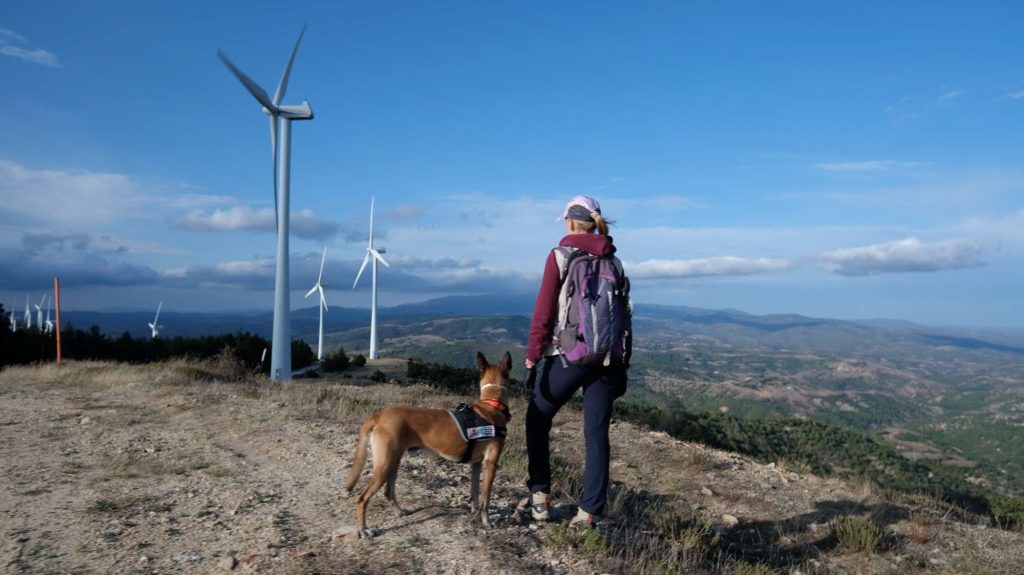
A dead common buzzard was found on 20 January 2026 at a wind station operating near the village of Melia, north of Alexandroupoli, during a systematic survey carried out by the Society for the Protection of Biodiversity of Thrace using a specially trained dog.
The bird was found in dense vegetation, approximately 80 metres from a wind turbine. It was already in an advanced stage of decomposition, and only parts of the body were located, which made the initial assessment of the incident difficult. It is estimated that the bird had been moved by a mammal to some kind of “hideout” and was partly consumed. The parts/remains that were found were collected and sent for veterinary examination.
According to the veterinary report, a complete fracture was identified in the left wing, while a part of it had been amputated, an injury that can be caused by a strong external force. Multiple crushing fractures were also observed in the remaining part of the body. Although the report concludes that the cause of death cannot be determined with certainty, similar types of fractures and amputations have been observed in past recorded cases of bird collisions with wind turbines.
It is noted that collisions of birds of prey have also been recorded in the past at the same wind station, highlighting the lack of proper planning for the installation of wind stations in areas critical for biodiversity, such as Thrace, and the significant underestimation of their impacts.
Once again, the role of the specially trained dog proved decisive, as it located the remains in a place where detection with conventional search methods used at wind stations would have been extremely difficult. The use of trained detection dogs is a valuable tool for locating and recording dead birds and bats at wind stations, thereby contributing to a better understanding of their impacts and to timely decision-making for existing projects to reduce impacts.
The systematic survey carried out by the Thrace Biodiversity Protection Society at wind stations in Evros and Rodopi using a trained dog is conducted within the framework of the European programme LIFE23-NAT-BG-LIFE Rhodope Vulture-101148254 “Restoration of the Cinereous vulture population and trophic chain in the Bulgarian-Greek cross-border region”.
We use cookies to give you the best possible experience on our site. If you continue to use the site, we will assume that you agree to this. Privacy policyΑΠΟΔΟΧΗΑπόρριψη
Privacy & Cookies Policy
Privacy Overview
This website uses cookies to improve your experience while you navigate through the website. Out of these, the cookies that are categorized as necessary are stored on your browser as they are essential for the working of basic functionalities of the website. We also use third-party cookies that help us analyze and understand how you use this website. These cookies will be stored in your browser only with your consent. You also have the option to opt-out of these cookies. But opting out of some of these cookies may affect your browsing experience.
Necessary cookies are absolutely essential for the website to function properly. These cookies ensure basic functionalities and security features of the website, anonymously.
Cookie
Duration
Description
cookielawinfo-checkbox-analytics
11 months
This cookie is set by the GDPR Cookie Consent plugin. The cookie is used to store the user consent for the cookies in the "Analytics" category.
cookielawinfo-checkbox-functional
11 months
The cookie is set by GDPR cookie consent to record the user consent for the cookies in the "Functional" category.
cookielawinfo-checkbox-necessary
11 months
This cookie is set by the GDPR Cookie Consent plugin. The cookies are used to store the user consent for the cookies in the "Necessary" category.
cookielawinfo-checkbox-others
11 months
This cookie is set by the GDPR Cookie Consent plugin. The cookie is used to store the user consent for the cookies in the category "Other.
cookielawinfo-checkbox-performance
11 months
This cookie is set by the GDPR Cookie Consent plugin. The cookie is used to store the user consent for the cookies in the "Performance" category.
viewed_cookie_policy
11 months
The cookie is set by the GDPR Cookie Consent plugin and is used to store whether or not the user has consented to the use of cookies. It does not store any personal data.
Functional cookies help to perform certain functionalities like sharing the content of the website on social media platforms, collect feedbacks, and other third-party features.
Performance cookies are used to understand and analyze the key performance indexes of the website which helps in delivering a better user experience for the visitors.
Analytical cookies are used to understand how visitors interact with the website. These cookies help provide information on metrics the number of visitors, bounce rate, traffic source, etc.
Advertisement cookies are used to provide visitors with relevant ads and marketing campaigns. These cookies track visitors across websites and collect information to provide customized ads.




 EN
EN  EL
EL