Assessment of the natural regeneration of conifer forests after the 2023 megafire in the Dadia Forest
Two years after the large wildfire of 2023, which burned over 94,000 hectares in Evros and became the largest recorded wildfire in Europe, nature is gradually beginning to recover. At the same time, a monitoring program on the natural regeneration of the region’s forest ecosystems is underway.
The study is being carried out on behalf of the Ministry of Environment and Energy by the consulting company MELIA S.A., in collaboration with the National and Kapodistrian University of Athens, the Democritus University of Thrace, the Ionian University and the Society for the Protection of Biodiversity of Thrace. Its aim is to assess the natural regeneration potential of the area’s two dominant conifer species — the Calabrian pine (Pinus brutia) and the black pine (Pinus nigra).
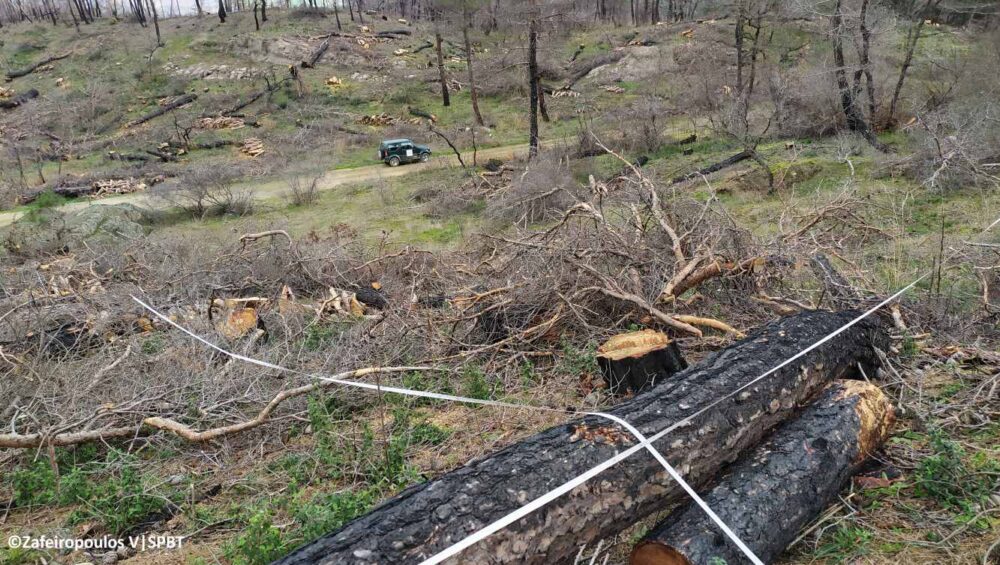
In the first phase, which was recently completed in 2025, sampling was conducted at 180 selected plots within the Dadia–Lefkimi–Soufli National Park, in areas of Calabrian pine. The plots were distributed as evenly as possible across three burn-severity classes (low, moderate and high) and across different post-fire management techniques (undisturbed areas, logging areas and areas where erosion-control structures were implemented).
The fieldwork focused on the quantitative recording of young established seedlings and on collecting data related to vegetation cover, microtopography and post-fire interventions. In parallel, statistical models were applied to identify the main variables influencing post-fire regeneration.
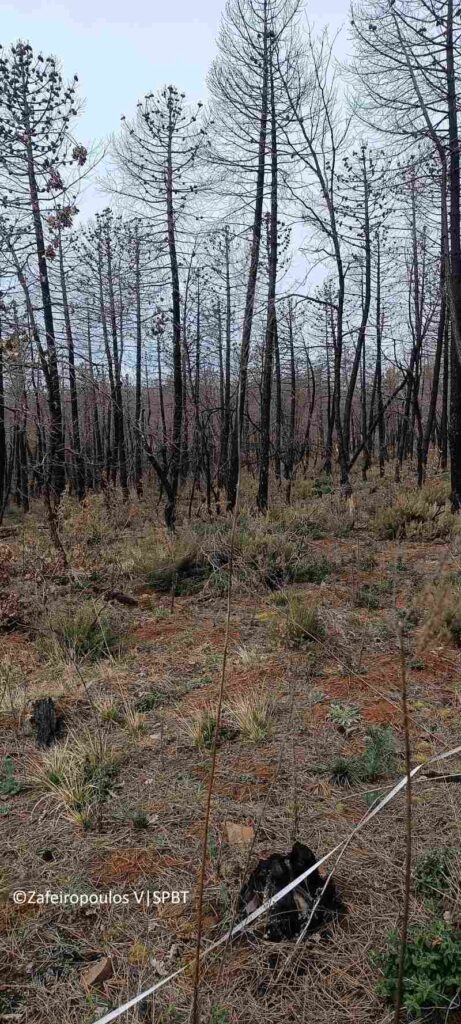
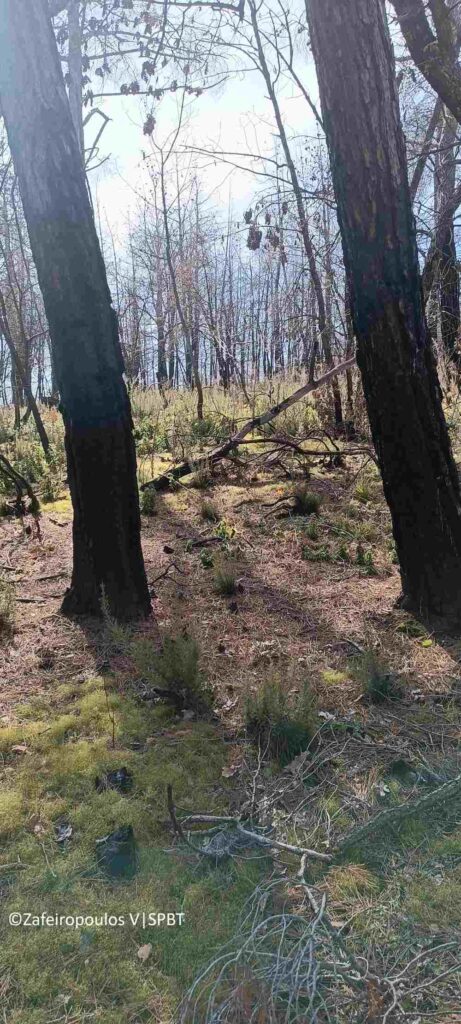
Post-fire regeneration, expressed as the number of established pine seedlings older than six months per square meter, showed high variation — from 0 to 26 individuals/m², with a mean density of 0.78 individuals/m². This density is considered satisfactory compared to similar studies in island ecosystems, where mean densities of 0.30 or 0.36 individuals/m² have been reported. For the first time, after accounting for multiple factors, it is demonstrated that burn severity is the most significant factor affecting the post-fire regeneration of Calabrian pine.. The highest densities were recorded in plots of low and moderate burn severity, while plots of high severity showed significantly lower regeneration density. Regeneration also varied according to post-fire management. Plots where dead wood was retained or where mild post-fire treatments were applied exhibited higher regeneration compared to areas where clear-cut logging occurred. The analysis further showed that, aside burn severity, exposure, slope and vegetation characteristics significantly influence regeneration. At this stage, distinguishing young individuals of Calabrian pine from those of black pine is not feasible, preventing conclusions in areas where the two species coexist.
Other forest species showed strong regeneration through resprouting in low- and moderate-severity areas, with heaths (Erica spp.), oaks (Quercus spp.) and Phillyrea spp. being dominant. Individuals of Cistus spp. were also abundant, originating from seed germination. Heath species appear to facilitate pine regeneration, whereas Cistus species act competitively. The growth of oak species is vigorous, as is typical for resprouting species.
Overall vegetation cover is at very good levels, indicating a reduced likelihood of soil erosion from wind or rain.
This study represents the first completed phase of a broader long-term monitoring program that will continue in the coming years. The project aims to track the progression of natural regeneration over time and identify areas where additional restoration measures may be required. The findings of the first phase highlight the inherent resilience of Mediterranean pine forests and emphasize the need for targeted management in the most degraded areas, providing essential data for future restoration planning.
 EN
EN  EL
EL