The regeneration of conifers in the Dadia – Lefkimi – Soufli Forest National Park following the 2023 Megafire.
In the summer of 2023, the Evros megafire affected a total area of 94,250 hectares. The majority of this area consisted of forests and forest areas, directly impacting the Dadia-Lefkimi-Soufli Forest National Park, where the second ignition point of the fire originated (Gkimprena peak). One year after the fire, our team, along with researchers from the National and Kapodistrian University of Athens, the Democritus University of Thrace, and the Ionian University, initiated the monitoring of the natural regeneration of conifers in Dadia National Park affected by the 2023 fire. This initiative was conducted within the framework of a project commissioned by the General Directorate of Forests and Forest Environment of the Ministry of Environment and Energy to the consulting firm MELIA S.A.
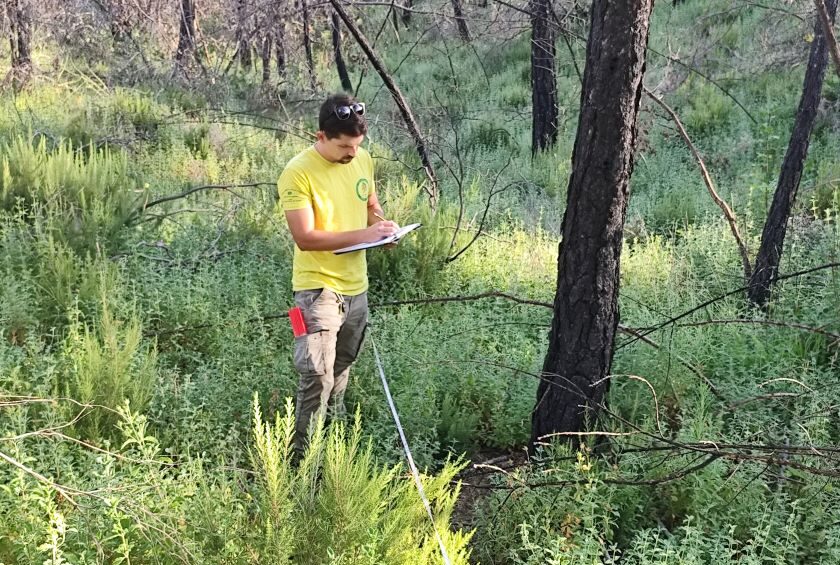
The monitoring of regeneration focused within the boundaries of Dadia National Park in areas formerly dominated by Calabrian pine (Pinus brutia) prior to the wildfire, either in pure stands or mixed with oak. One of the primary objectives of the study was to evaluate the effect of fire severity as well as post-fire management practices on conifer regeneration. A total of 180 sampling sites were selected, and within each site the natural regeneration was recorded across 3 sampling plots. The 180 sites were equally divided into three fire severity categories (high, moderate, low), as well as into areas where post-fire interventions (logging, anti-erosion works) had taken place or not.
The survey demonstrated that the fire severity is the most decisive factor for the natural regeneration of Calabrian pine. Areas burned at high severity exhibited the lowest levels of regeneration compared to corresponding areas of low and moderate severity. The pine regeneration was higher in sites where burned timber had not been removed and where log erosion barriers had been installed. On the contrary, sites subjected to logging, either alone or in combination with log erosion barriers, generally displayed lower seedling densities across all fire severity categories. Pine regeneration was higher on northern slopes and lower on steep slopes. Woody plant cover in the understory was higher in high-severity sites, dominated by rockrose species (Cistus spp.) and, to a lesser extent, heaths (Erica spp.) and oaks (Quercus spp.), indicating a shift in dominance toward these species during the early stages of plant community recovery. Soil mosses were more abundant in areas affected by high and moderate-intensity fires, likely reflecting their ability to colonize exposed substrates and contribute to ecosystem recovery in the initial stages following disturbance. Low-severity areas favored the growth of grasses and other herbaceous plants, displaying a negative correlation between the cover of these species and the occurrence of pine seedlings.
The post-fire assessment conducted within the framework of this study provides valuable initial insights into the future trajectory of conifer forest restoration. However, the results may not reflect long-term regeneration dynamics due to potential seedling mortality during summer periods and the ongoing establishment of new pine individuals over subsequent years—albeit with low probability—conditions that can influence interspecific competition dynamics and shape the future composition of the forest plant community. Our objective this year is to continue monitoring the progress of regeneration and focus on areas with the presence of Black pine (Pinus nigra). Continued monitoring over the coming years will yield a more comprehensive understanding of natural recovery processes and support evidence-based post-fire management decisions in the future.
Our objective this year is to continue monitoring the progress of regeneration and focus on areas with the presence of Black pine (Pinus nigra). Continued monitoring over the coming years will yield a more comprehensive understanding of natural recovery processes and support evidence-based post-fire management decisions in the future.
Detailed results of the 2025 natural regeneration recording can be found in the scientific article here.
 EN
EN  EL
EL