“Alliance for Wildlife”: Why nature wants us on the same team
Eleven organisations, one team, united in the fight for the well-being of wildlife and people.
Under the central slogan “Nature wants us on the same team”, the new communication campaign launched today by the“Alliance for Wildlife”serves as a reminder that in the struggle for the well-being of wildlife and humans alike, we are all in this together.
The “Alliance for Wildlife” is an ambitious collective initiative: a team of eleven (11) environmental organisations with significant experience, which through the wide range of their actions work towards a common goal — the effective protection of well-known and lesser-known species of critical importance to Greece, as well as their ecosystems.
Just as the success of a team depends on the effort of each individual player, the impact of the “Alliance for Wildlife” is driven by the work and dedication of the following environmental organisations:
- ANIMA – Association for the Protection and Care of Wildlife
- ARCHELON – Sea Turtle Protection Society of Greece
- CALLISTO – Environmental Organisation for Wildlife and Nature
- Hellenic Ornithological Society
- Society for the Protection of Biodiversity of Thrace
- Society for the Protection of Prespa
- Hellenic Institute of Speleological Research
- iSea – Environmental Organisation for the Protection of Aquatic Ecosystems
- MEDASSET – Mediterranean Association to Save the Sea Turtles
- TETHYS Research Institute
- WWF Greece
Greece is home to more than 27,000 recorded animal species, 4,000 of which are endemic. At a time, however, when wildlife and ecosystems worldwide are being pushed beyond their limits due to climate change and environmental degradation, immediate and coordinated action is required. For this reason, this unique alliance operates on land, in the air, at sea and in rivers, across the entire country, focusing on emblematic and threatened species of Greek fauna.
As the Alliance completes its third year of operation, it can already demonstrate significant results. Indicatively, the following actions have been implemented during this period:
- ANIMA: Analysis of the largest wildlife incident database in Greece, comprising over 62,000 cases of injury, poisoning or killing of wildlife caused by human activities. The aim is to better understand the threats facing wildlife, support the development of effective mitigation policies, and improve diagnosis and treatment of wild animals.
- Hellenic Ornithological Society:
- Completion of the national census of Eleonora’s Falcon after 20 years, recording more than 13,000 breeding pairs across over 1,000 islands and islets in the Aegean and Ionian Seas.
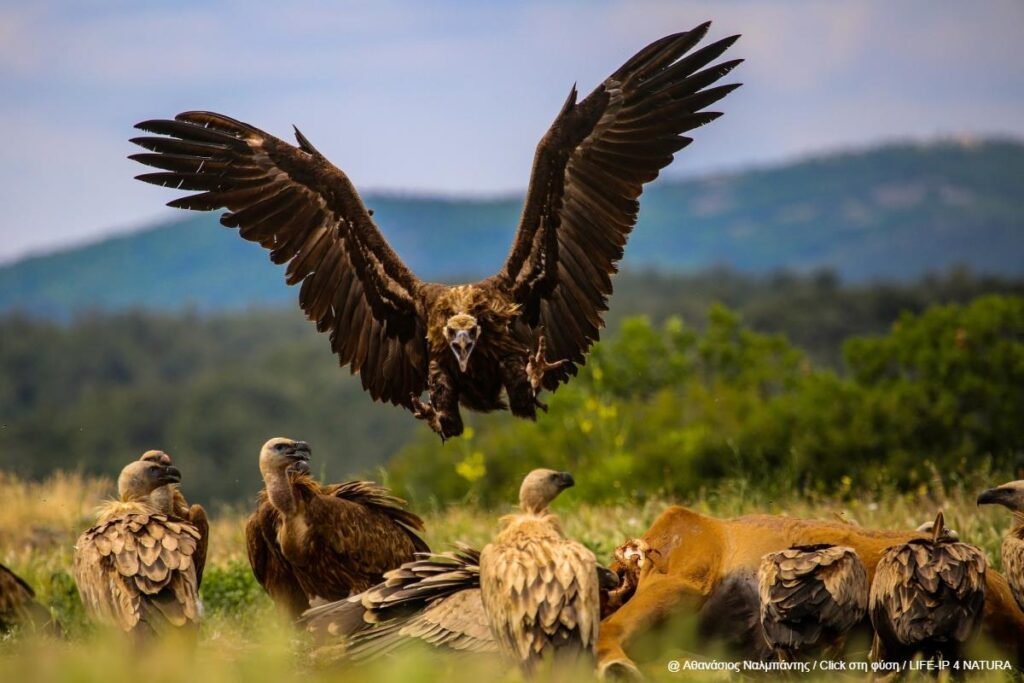
- Awareness-raising and collaboration initiatives with farmers and livestock breeders in Epirus to promote alternative livestock protection practices, reducing the use of poisoned baits — a major threat to vultures and other species.
- Society for the Protection of Biodiversity of Thrace:
- Organisation of training seminars for competent public authorities on the proper management of poisoning incidents, as well as awareness actions for hunters regarding research findings on wolf populations and their interaction with hunting dogs.
- Joint actions with the Hellenic Ornithological Society to support appropriate spatial planning of wind farms in Thrace, safeguarding vultures and other raptors.
- Society for the Protection of Prespa: Preparation of a feasibility study for the restoration of the ecological functions of the Agios Germanos River in Prespa, aiming to protect nine endemic fish species.
- iSea:
- Development of a rapid identification tool for 16 protected shark and ray species in Greek seas, facilitating detection in trade by enforcement authorities and improving awareness among professional fishers.
- Promotion of Citizen Science to enhance knowledge on marine species (26,000 new users on the iNaturalist platform and 400 participants in scientific Bioblitz events).
- MEDASSET: Awareness-raising among fishers in Zakynthos on best practices for safely releasing sea turtles from fishing gear, as well as the implementation of five underwater clean-ups in loggerhead turtle habitats, removing over 100 kilograms of plastic waste.
- Hellenic Institute of Speleological Research: Provision of scientific documentation and policy proposals to national and European authorities to improve the legal framework for the protection and management of cave-dwelling species and their habitats.
- CALLISTO: Documentation of over 1,400 wolves in Greece and provision of scientific data on wolf–dog hybridisation. In addition, in collaboration with six other organisations, CALLISTO co-established the Large Carnivores Observatory to monitor conservation and management issues related to large carnivores.
- ARCHELON and WWF Greece: Assessment of more than 100 loggerhead sea turtle nesting beaches, with the support of hundreds of citizen volunteers, recording conditions and barriers affecting nesting activity.
- TETHYS Research Institute and WWF Greece: Strengthening research and conservation of cetaceans in the Hellenic Trench using the research vessel Blue Panda. During the two missions carried out so far, researchers collected data on cetaceans (sperm whales, Cuvier’s beaked whales and dolphins), highlighting the urgent need to protect marine mammals.
- WWF Greece:
- Mapping the connectivity of Natura 2000 sites for large mammals, in collaboration with the University of the Aegean. Furthermore, together with ELGO–DIMITRA and CALLISTO, potential ecological corridors were assessed for the isolated red deer population of Mount Parnitha. Actions are currently underway to identify barriers and encourage the species’ natural expansion towards Boeotia.
- Securing commitments from seven shipping companies to voluntarily adopt route-adjustment measures, reducing the risk of ship strikes with sperm whales in the Hellenic Trench. This action was implemented in collaboration with the Pelagos Institute, OceanCare and the International Fund for Animal Welfare (IFAW).
- Awarding a total of 20 scholarships of €10,000 each to early-career researchers for field research and studies on threatened and rare species of Greek fauna, in collaboration with the Hellenic Zoological Society and the Hellenic Herpetological Society.
On behalf of the Alliance, Panagiota Maragkou, Head of Environmental Protection Programmes at WWF WWF Greece, stated: “For many years, several environmental organisations have been working, each in its own field, to protect wildlife. However, no single organisation can achieve what we can accomplish together. Our shared love for nature, along with the recognition of the growing threats facing wildlife, led us to join forces and work in a more coordinated manner to protect Greece’s biodiversity. Through collaboration, the Alliance for Wildlife seeks to amplify the impact of every individual effort, for the benefit of nature and people alike. Because nature wants us on the same team.”
Learn more about the Alliance for Wildlife on the initiative’s official website: www.greekwildlifealliance.gr
 EN
EN  EL
EL